Dance Track Pants and the Case for Staying Warm Between Numbers
Most conversations about warming up focus on the fifteen minutes before class. Far less attention goes to what happens after, during the long gaps that fill a competition day, a rehearsal block with sectional work, or the stretch between a morning technique class and an afternoon call. Muscle temperature falls faster than most dancers expect, and it falls fastest in a cold studio or a drafty backstage corridor. This is the practical argument for dance track pants, which do a specific physiological job rather than serving as casual filler in a dance bag.
Understanding that job makes the buying decision much clearer.
What Happens to a Muscle That Cools Down
Warm muscle tissue is more extensible. Elevated tissue temperature improves the elasticity of muscle and connective tissue, which is the entire point of a warm-up and a meaningful factor in reducing strain injuries.
That benefit is not permanent. Once activity stops, tissue temperature begins returning toward baseline, and the effect is accelerated by cool ambient air and by sweat evaporating off the skin. A dancer who warms up thoroughly at nine, sits in a cold hallway until eleven, and then goes straight into full-out choreography is asking a lot of the body.
Insulating layers slow that loss. They do not replace an active warm-up, and no garment will, but they preserve more of the work already done, which reduces how much needs redoing.
The Windows That Matter Most
Three moments account for most of the risk.
Between warm-up and first marking. Common in competition settings, where call times and stage times rarely align neatly.
Between numbers. A dancer performing multiple routines may wait an hour or more between them, often in a space with no temperature control.
During instruction and notes. Any rehearsal involving standing, listening, and waiting while other sections work. This is easy to overlook because it feels like the class is still in progress.
In each case the fix is the same. Cover the legs, keep them covered until movement resumes, and remove the layer quickly when it does.
Cut and Closure: What Actually Works in a Studio
The removability question is where a lot of pants fail. A garment that requires sitting down and pulling it over shoes will stay in the bag.
Side snaps or full-length zips are the most functional option. They come off over sneakers or dance shoes in seconds, which means the dancer will actually use them rather than skipping the layer to avoid the hassle.
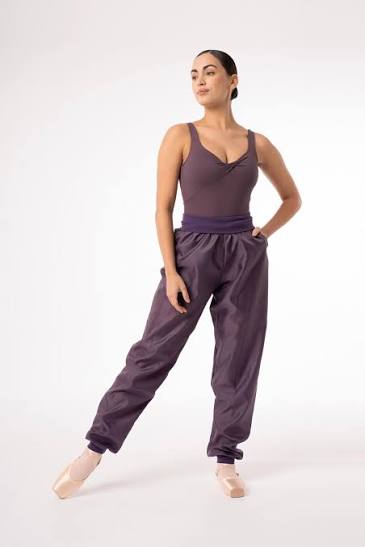
Elastic or cuffed hems stay in place during floor work and keep the fabric clear of the feet. Open or wide hems drag and can catch, particularly on stairs and in crowded backstage areas.
A tapered leg through the calf reduces excess fabric without restricting the knee. Fully fitted pants restrict deep plié and are not ideal for a garment meant to be worn while moving between spaces.
Waistband should sit high enough to stay put through bending and stretching. A drawstring inside an elastic band gives the most adjustability, which matters during growth years.
Fabric Weight and the Overheating Trap
Heavier is not automatically better. A dancer who overheats will strip the layer off and leave it off, defeating the purpose entirely.
Mid-weight fabric with some breathability generally outperforms heavy fleece in a working studio. Look for a knit that traps warmth without becoming saturated, since damp fabric against skin actively pulls heat away. If the pants will be worn over sweaty legs after class, breathability matters more than insulation.
For genuinely cold venues, a mid-weight pant plus a base layer works better than a single heavy garment, because it can be adjusted.
Competition and Audition Day Considerations
Competition days involve makeup, hair, and costumes that cannot be disturbed. Side-opening pants come off without going over the head or catching a hairstyle, which is a real advantage over pull-on styles.
Color is worth a thought as well. Many teams standardize on a single color for a coordinated look in the audience and in photographs. Check whether your studio has a preference before buying.
For auditions, pants that come off cleanly in the holding area let a dancer stay warm until the moment they walk in.
Care and Rotation
Wash cold, skip the dryer, and avoid fabric softener, which coats fibers and reduces breathability. Two pairs in rotation is usually sufficient, since track pants absorb less sweat than pieces worn against the skin during full-out work.
Check elastic and closures periodically. Snaps loosen with heavy use, and a pant that will not stay fastened stops being useful.
Getting Started
Track pants are equipment rather than accessory. Prioritize fast removal, a hem that stays clear of the feet, mid-weight breathable fabric, and a waistband that holds through movement. Get those four right and the layer will actually get worn, which is the only version that helps. Tiger Friday builds bottoms designed around how dancers move between studio, backstage, and stage. Browse the range to find a pair that earns its place in the bag.