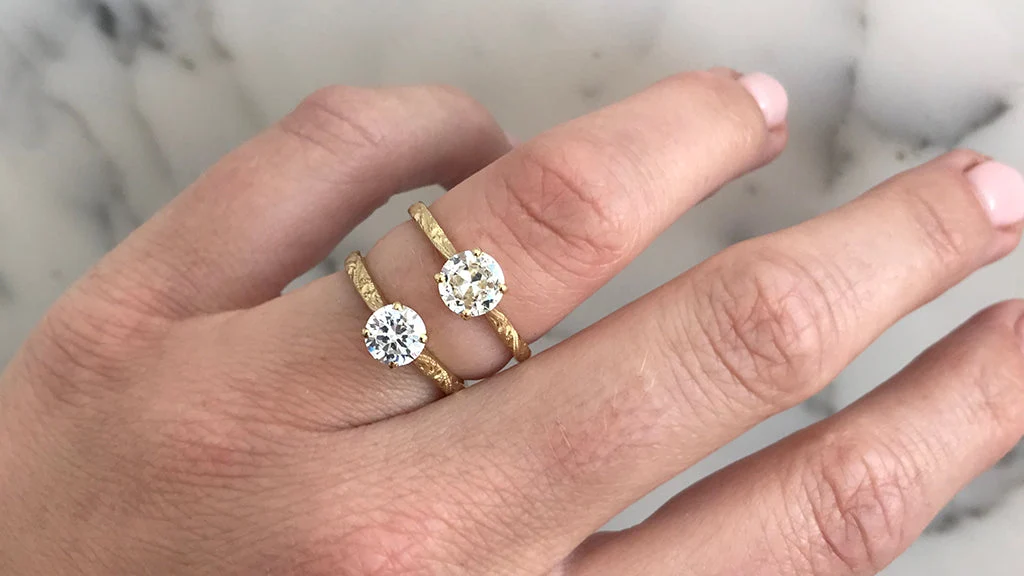
Why an Old Cut Diamond Is a Choice, Not a Compromise
Most people come to vintage diamond rings having already absorbed a modern standard for what a diamond should look like, and the first period stone they see does not meet it. It flashes broadly rather than finely. It shows color where a contemporary stone would show white light. It may look softer, warmer, less precise. The instinct is to read this as inferiority, and it is worth correcting, because the differences are the result of stones cut deliberately for a different purpose than the ones being cut today.
They were cut for the light that existed
A diamond cut in 1910 was going to spend its evenings under candlelight, gaslight, or early electric bulbs. All of these produce warm, low, flickering illumination.
Cutters responded with proportions suited to it: smaller tables, higher crowns, deeper pavilions, and larger facets. The result is a stone that returns light in broad, distinct flashes with visible color separation, which is exactly what reads well in a dim room. Modern brilliant cuts, optimized under bright, even, cool light, deliver finer and more numerous flashes and considerably more white return.
Neither is better in the abstract. They are solutions to different lighting problems, and the older one still performs beautifully in the settings most people actually spend their evenings in.
What you are looking at
Old mine cuts are the earlier form: cushion-shaped outline, high crown, small table, and an open culet, which appears as a small circle at the center when you look straight down through the stone. Hand-cut, and often slightly asymmetrical.
Old European cuts followed as cutting became more mechanized. Round in outline, still with a high crown and small table, and usually still showing a culet.
Transitional cuts occupy the ground between the old European and the modern brilliant, appearing through the 1930s and 1940s.
Rose cuts are different again: flat-backed with a faceted dome on top and no pavilion at all, producing a soft glow rather than sparkle.
The culet is the quickest identifier. Look straight down through the table. A small circle at the bottom means an older cut. A point means modern.
The asymmetry question
Hand-cut stones are rarely perfectly symmetrical, and modern grading treats deviation from symmetry as a fault. Applied to a period stone, that judgment is misplaced.
The slight irregularity is what produces the individual character of the flashes. Two old European cuts of identical weight and color will not look the same, which is the appeal. If uniformity is what you want, a modern stone will deliver it more reliably and there is nothing wrong with wanting that.
What actually to evaluate
Since modern grading criteria fit these stones imperfectly, judge on what matters for a stone you will look at daily.
Look at it in the light you live in. Ask to see it under warm indoor lighting rather than a jeweler’s lamp, which is calibrated for modern stones and will make an old cut look flat.
Consider face-up appearance over paper weight. Old cuts carry more of their mass in the crown and pavilion, so a period stone often looks smaller face-up than a modern one of the same carat weight. It also means you are frequently paying less per visible millimeter.
Ask about the setting’s originality. Whether a stone is original to its mount, or was reset at some point, affects both value and how the piece should be understood. Either can be perfectly legitimate. It should simply be disclosed.
And ask about condition rather than grade: chips at the culet or girdle, surface-reaching feathers in exposed positions, and any treatment history.
The thing modern stones cannot offer
A period diamond has already been worn by someone, through a life you will never know the details of, and it will outlast you as comfortably as it outlasted them. That is not a value argument, and it should not be made into one. It is simply the part of the appeal that no new stone can replicate.
To see how period stones are examined and their condition described before sale, browse the collection at Gesner Estate Jewelry, where each ring is hand selected and evaluated. Look at an old cut in the light you actually live in, and the comparison usually settles itself.